Book summary
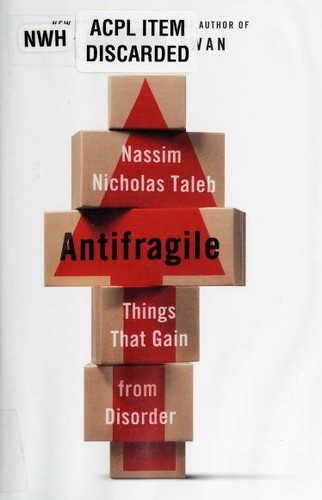
Antifragile
Summary
Introduction
Nassim Nicholas Taleb’s Antifragile challenges the conventional wisdom that stability is always good and volatility is always bad. Building on his previous works Fooled by Randomness and The Black Swan, Taleb introduces a powerful new concept: antifragility. While a fragile system breaks under stress and a robust system resists it, an antifragile system gets stronger. It thrives on chaos, uncertainty, and disorder. In a world that is increasingly complex and prone to unpredictable events, Taleb argues that our goal should not be to merely survive the unexpected, but to position ourselves to benefit from it.
The Triad: Fragile, Robust, and Antifragile
To understand antifragility, one must first distinguish it from resilience. Taleb uses the metaphor of the Phoenix and the Hydra. The Phoenix is robust; it dies and is reborn, returning to the same state after a catastrophe. The Hydra is antifragile; when one head is cut off, two grow back, making it stronger than before. Similarly, an egg is fragile because stress breaks it. A rock is robust because stress does not affect it. Human muscles and bones, however, are antifragile because they strengthen under the load of exercise. This distinction is crucial because modern society often confuses the robust with the antifragile, striving for a stability that actually weakens us.
The Problem with Modernity
Taleb argues that modernity often harms us by trying to eliminate variability. We attempt to smooth out economic cycles, sterilize our environments, and predict the unpredictable. This “touristification” of life deprives systems of the necessary stressors that trigger growth. For example, humans prevent forest fires to protect trees, only to face catastrophic wildfires later because the undergrowth was never cleared. By suppressing small volatility, we create a buildup of risk that eventually leads to a massive collapse. True stability requires accepting small fluctuations to avoid large disasters.
The Barbell Strategy
One of the most actionable concepts in the book is the barbell strategy. This is a method to achieve antifragility by combining two extremes and avoiding the middle. In practical terms, this means being extremely conservative in some areas to ensure survival, while being extremely aggressive in others to capture upside potential. For instance, in finance, you might keep 85% to 90% of your wealth in safe cash reserves (protecting against downside) and put the remaining 10% to 15% in highly speculative, high-risk ventures (exposing yourself to unlimited upside). In your career, this might look like keeping a stable, boring job while pursuing a high-risk passion project on the side. This approach limits your exposure to negative Black Swans while leaving you open to positive ones.
Via Negativa: The Power of Subtraction
Taleb emphasizes that we generally know more about what is wrong than what is right. Therefore, the path to improvement is often through subtraction, a method he calls via negativa. Instead of adding medications, supplements, or complex rules to our lives, we should focus on removing harmful elements. In health, this means removing sugar and processed foods before adding drugs. In decision-making, it means removing options that lead to fragility. This philosophy also applies to information: rationing the supply of information can reduce stress and improve clarity, whereas too much noise can fragilize the mind.
Optionality and the Value of Randomness
Another key to antifragility is optionality-the ability to alter your course as new information arises. Options are valuable because they allow you to benefit from volatility without a corresponding heavy downside. Taleb suggests that having options is a substitute for knowledge; you don’t need to predict the future if you are positioned to take advantage of whatever happens. This is why tinkering and trial and error are superior to top-down planning. Real-world innovation comes from practical experimentation, not from theoretical models. By ensuring you always have a way out or a new path to take, you render yourself antifragile to unforeseen events.
Skin in the Game
Taleb repeatedly stresses the importance of “skin in the game.” Decision-makers must bear the risks of their decisions. If a CEO can gamble with the company’s money and walk away with a bonus regardless of the outcome, the system is fragile. Real antifragility requires that those who make decisions are the ones who suffer the consequences of failure. This aligns the incentives of the individual with the reality of the world, preventing the transfer of fragility from the powerful to the collective. This principle applies to politics, economics, and personal life: never trust someone who gives you advice without facing the risks of that advice themselves.
Practical Applications for Life
To become antifragile, Taleb recommends embracing randomness and stressors in your personal life. Physically, this involves lifting heavy weights or fasting, which provide acute stress that strengthens the body. Mentally, it means putting yourself in situations where you can learn from mistakes. If you succeed, do not rest on your laurels, as success can make you fragile by giving you too much to lose. Instead, practice Stoicism and “practicing poverty” to inoculate yourself against the fear of losing your status. Finally, avoid the “middle ground” in all things. Respectable mediocrity is often the most fragile place to be. Choose either safety or calculated risk, but never the murky middle where hidden risks often lie.