Book summary
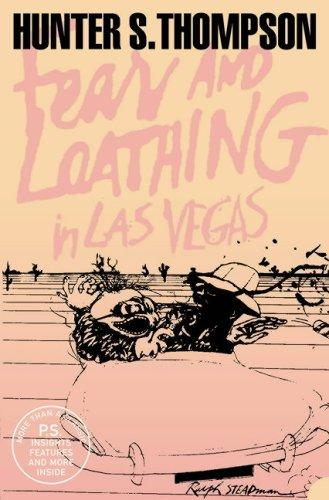
Fear and Loathing in Las Vegas
Summary
A Savage Journey to the Heart of the American Dream
“We were somewhere around Barstow on the edge of the desert when the drugs began to take hold.” This iconic opening line sets the tone for Hunter S. Thompson’s Fear and Loathing in Las Vegas. Published in 1971, the book is a seminal work of “gonzo journalism,” a style that rejects the idea of objective reporting in favor of a highly subjective, first-person narrative where the author becomes an integral part of the story.
The novel follows Raoul Duke, Thompson’s alter ego, and his attorney, Dr. Gonzo, a character based on the Mexican American activist Oscar Zeta Acosta. The duo travels from Los Angeles to Las Vegas in a red convertible called the “Great Red Shark.” Their official mission is to cover the Mint 400 motorcycle race for a sports magazine and later report on a National District Attorneys’ Conference on Narcotics and Dangerous Drugs. However, stocked with a massive inventory of illicit drugs, their journey quickly spirals into a chaotic search for the American Dream.
The Birth of Gonzo Journalism
Thompson’s approach to storytelling was revolutionary. He blended fact, fiction, and fantasy to create a “roman à clef”-a novel based on real-life events. While the trips to Vegas actually occurred, Thompson exaggerated the drug use and hallucinations to grotesque proportions. He admitted that he never quite figured out how the reader was supposed to know the difference between journalism and fiction, but he believed that “the best fiction is more true than any kind of journalism.”
By inserting himself into the narrative as Duke, Thompson was able to offer a social critique wrapped in self-satire. The book does not just report on Vegas; it assaults the city. Thompson described the work as a “failed experiment” in gonzo journalism, but it succeeded in capturing the zeitgeist of the post-1960s era. The style allows the reader to experience the sheer terror and euphoria of the drug-induced haze, making the cultural commentary visceral rather than theoretical.
Las Vegas as the Stage for Decay
Las Vegas serves as the perfect backdrop for Thompson’s critique. He viewed the city as the ultimate postmodern destination, a place that demands a specific type of behavior: spending money and obeying rules. The protagonists resist this by altering their reality so thoroughly with drugs that they cannot possibly respond in the way the city commands.
The book portrays Vegas as a “vile epitaph” for the American Dream. Duke and Gonzo encounter absurdity at every turn. They attend the drug conference, a farcical event where police experts, completely out of touch with reality, attempt to educate law enforcement on narcotics. The irony of two drug-addled outlaws listening to cops discuss the dangers of drugs highlights the hypocrisy of the era’s “war on drugs.” The book suggests that in a closed society where everyone is guilty, the only crime is getting caught.
The Death of the 1960s Counterculture
Beneath the lurid descriptions of drug use and the manic encounters with hitchhikers, waitresses, and terrified teenagers, lies a deep melancholy. Thompson is mourning the failure of the 1960s counterculture. He captures this sentiment perfectly in the “wave speech,” a passage where he describes the “high and beautiful wave” of the 60s that finally broke and rolled back.
The book is set in 1971, a time Thompson described as an “abysmal era” in American history. The optimism and momentum of the previous decade had crashed against the walls of a harsh reality dominated by the Vietnam War and the Nixon administration. Duke and Gonzo are the remnants of that failed revolution, stranded in a desert of excess with no place left to go. They are self-destructive, paranoid, and “willfully stupid,” embodying the darker side of the freedom they once sought.
The Search for Meaning in Excess
Duke and Gonzo’s journey is a frantic quest for the American Dream. They look for it in the strip clubs, the casinos, and the ether-soaked halls of the Circus Circus, but they find only emptiness. The novel argues that the Dream has become a grotesque distortion of its original intent. It is no longer about freedom or opportunity, but about over-consumption and greed.
The characters do not learn, and they do not grow. There is no moral redemption or character arc. This lack of resolution is intentional. It reinforces the idea that there is no escape from the condition of American life in the 70s. The only option is to keep moving, to “buy the ticket and take the ride,” even if the ride leads nowhere.
Key Takeaways
- Embrace Subjectivity: Thompson showed that personal bias and participation can reveal truths that detached observation misses.
- Question Authority: The book relentlessly mocks institutions, from the police to the press, encouraging skepticism toward those in power.
- Acknowledge the Past: Understanding the collapse of the 60s idealism provides context for modern cynicism and political disillusionment.
- The Cost of Freedom: The novel illustrates that absolute freedom, without responsibility, can lead to chaos and self-destruction.
Fear and Loathing in Las Vegas remains a powerful cultural artifact. It is a hilarious, terrifying, and insightful look at a nation turning a gun on itself. While the drugs may provide the spectacle, the substance of the book is its unflinching examination of the American psyche.