Book summary
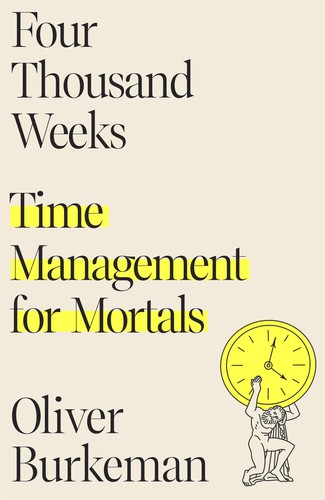
Four Thousand Weeks
Summary
The Reality of Finite Time
The average human lifespan is absurdly, insultingly brief. If you live to be eighty, you will have had about four thousand weeks. While this statistic can be terrifying, Oliver Burkeman argues in this book that confronting our radical finitude is the key to a fulfilling life. Modern society encourages us to believe that if we just manage our time efficiently enough, we can eventually conquer our to-do lists and control our futures. This is a delusion. The day will never arrive when you have everything under control, when no one is angry with you, and when you can finally turn to the things life is supposed to be about.
The trouble with attempting to master your time is that time ends up mastering you. When we treat time as a resource to be hoarded or spent perfectly, we create immense pressure. This pressure stems from a shift that occurred historically with the invention of clocks. Before clocks, people lived in a task-oriented world where the rhythms of life emerged organically from the work at hand. Today, we treat time as an abstract commodity to be bought, sold, and used. This results in the efficiency trap: rendering yourself more efficient rarely results in the feeling of having enough time because the demands on you will simply increase to offset any benefits. You will never catch up. Accepting that you won’t have time for everything is the first step toward freedom.
Rediscovering Meaning in Limitation
Burkeman suggests that our limited time is actually what makes life valuable. If we lived forever, our choices would not matter. It is the finitude of existence that gives our decisions weight. He encourages embracing the joy of missing out, which is the thrilling recognition that if you did not have to decide what to miss out on, your choices could not truly mean anything. Every choice we make involves closing off the possibility of countless other choices. This is not a tragedy but a definition of meaning.
One of the hardest aspects of time management is knowing what to do when far too many things feel at least somewhat important. The struggle is not to prioritize the schedule but to schedule your priorities. This requires deciding what to neglect. You must choose which tasks to focus on and which to actively let fail. Living life to the fullest requires settling. You cannot have it all, do it all, or be it all. Committing to one path, such as a relationship or a career, means giving up the rewards of others. To live meaningfully, you must abandon the perfectionist fantasy that you can keep every option open.
Breaking Free from the Attention Economy
In our daily lives, we face the problem of distraction. Burkeman argues that distractions are often motivated by the desire to flee something painful about our experience of the present. We scroll through social media or check our phones to seek relief from the discomfort of confronting our limitations. The attention economy thrives on this, using outrage and extremes to grab our focus. However, attention just is life. Your experience of being alive consists of nothing other than the sum of everything to which you pay attention. At the end of your life, whatever compelled your attention from moment to moment is simply what your life will have been.
Resisting this distraction requires facing the discomfort of reality. Instead of going against the feeling of limitation, we should acknowledge and accept it. We must recognize that our devices don’t just distract us from important matters; they change how we define what is important in the first place. To counter this, we should pay more attention to the mundane moments of life. We should ask ourselves if we are using our technology or if it is using us. Reclaiming our attention is an act of reclaiming our life.
Patience and Uncertainty
We live in an age of hurry, but patience is a virtue. The book posits that sticking with something allows for meaningful accomplishments. In a world obsessed with speed, the ability to let things take the time they take is a superpower. This involves developing a taste for having problems rather than trying to eliminate them all, and embracing radical incrementalism by making small daily progress on big goals.
Furthermore, we must deal with the anxiety of the future. Hofstadter’s law states that tasks always take longer than you expect, even when you factor in the law itself. Planning is essential, but the future is unpredictable and uncontrollable. By not demanding certainty that things will go exactly as planned, we can let go of anxiety. No amount of planning can remove the inherent uncertainty of being alive. We must learn to be comfortable with not knowing.
Practical Tools for Embracing Finitude
The book concludes with practical tools for living a limit-embracing life. One key tool is to adopt a fixed volume approach to productivity. This means establishing predetermined time boundaries for daily work and stopping when the time is up, rather than letting work expand to fill all available time. Another tool is to serialize: focus on one big project at a time instead of multitasking.
You should also decide in advance what to fail at. Identify which areas you will neglect. It is helpful to keep a done list to focus on what you have already completed rather than just what remains. Additionally, you should consolidate your caring by consciously choosing which causes or people to support and accepting you cannot care deeply about everything.
On a personal level, Burkeman recommends seeking out novelty in the mundane and practicing instantaneous generosity. When a generous impulse arises, act on it immediately. Perhaps most importantly, practice doing nothing. There is liberation in grasping that you are a limited human. By embracing cosmic insignificance therapy, you realize that the universe does not care how you use your time. This realization frees you from unreasonable standards and allows you to spend your finite time focused on a few things that matter to you, right now, in this moment.