Book summary
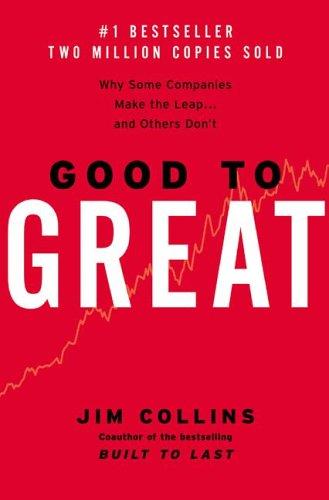
Good to Great
What separates enduring companies from merely decent ones.
Summary
Why do some companies make the leap from good to great while others remain stagnant? Jim Collins and his research team spent years analyzing data to answer this question. They found that the enemy of greatness is often goodness itself; companies become complacent with being good and never strive for greatness. The transition is not a single event but a process of building momentum, which Collins describes as the Flywheel Effect. It involves three stages of discipline: disciplined people, disciplined thought, and disciplined action. Greatness is not a function of circumstance or glamorous industry, but rather a matter of what you do within your control.
The journey begins with leadership. Collins introduces Level 5 Leadership, a paradoxical blend of personal humility and professional will. These leaders are ambitious for the company, not themselves, and often channel their ego needs into building a great organization. Before a strategy can be set, great companies adhere to the principle “First Who, Then What.” This means getting the right people on the bus and in the right seats. The right people are self-motivated and do not need to be managed; they are driven by an internal code to do the right thing.
With the right team in place, the company must engage in disciplined thought. This involves two main concepts: confronting the brutal facts and the Hedgehog Concept. Companies must practice the Stockdale Paradox-maintaining unwavering faith that they will prevail in the end, regardless of the difficulties, while simultaneously confronting the most brutal facts of their current reality. They must also find their Hedgehog Concept. This is the intersection of three circles: what you can be the best in the world at, what drives your economic engine, and what you are deeply passionate about. Companies that focus on their Hedgehog Concept understand that they can do many things, but they should only do things they can be the best at.
Finally, great companies build a culture of discipline. This is not about tyranny or bureaucracy, but about self-disciplined people who adhere to the company’s core values. In this environment, technology acts as an accelerator, not a driver. Successful firms use technology to enhance their Hedgehog Concept, not to create a competitive advantage out of thin air. They avoid the fear of missing out and only adopt tech that supports their core strategy. All these elements combine to create the Flywheel Effect. Success is not a single push or a miracle moment, but the accumulation of consistent effort in the right direction. By pushing the flywheel, companies build momentum that eventually becomes unstoppable. Ultimately, greatness is attained through rigorous adherence to these principles, ensuring the organization endures beyond any single leader.