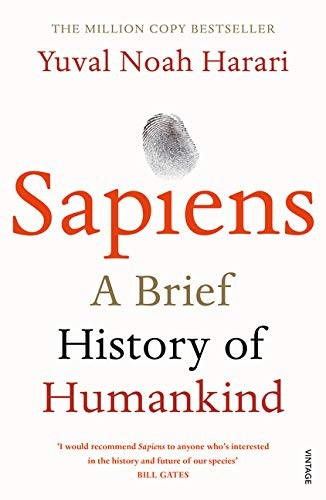
Book summary
Sapiens
Summary
Sapiens: A Brief History of Humankind surveys the history of our species from the Stone Age to the twenty-first century. Yuval Noah Harari divides history into four major revolutions: Cognitive, Agricultural, Unification of Humankind, and Scientific. The central thesis is that Homo sapiens dominate the planet not because of individual intelligence, but because of our unique ability to cooperate flexibly in large numbers. This cooperation is made possible by our capacity to believe in shared fictions or “inter-subjective realities”-concepts that exist only in the collective imagination, such as money, gods, nations, and human rights. While the Agricultural Revolution allowed the population to grow, Harari argues it often worsened the individual quality of life for humans and caused immense suffering to domesticated animals. The book suggests that history is the gradual unification of humankind, driven by money, empires, and universal religions, culminating in a global empire. The Scientific Revolution, characterized by the admission of ignorance and the desire to conquer nature, granted humans god-like powers to create and destroy species. Ultimately, despite these leaps in power, Harari questions whether we are any happier than our ancestors, warning that future biotechnological developments may soon end our species as we know it.