Book summary
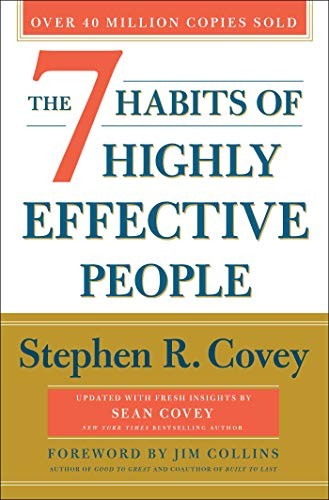
The 7 Habits of Highly Effective People
Timeless principles for personal leadership and effectiveness.
Summary
Stephen R. Covey’s The 7 Habits of Highly Effective People is not a collection of quick productivity hacks, but a framework for character development and personal change. Published in 1989, the book emphasizes the ‘character ethic’ over the ‘personality ethic,’ arguing that true effectiveness comes from aligning with core principles. Covey structures the book around seven habits that progress from personal independence to interdependence and ongoing renewal.
The first three habits constitute the ‘Private Victory,’ helping individuals achieve self-mastery. Habit 1, Be Proactive, teaches that we have the freedom to choose our response to any stimulus, urging us to focus on our circle of influence. Habit 2, Begin with the End in Mind, requires envisioning the future and creating a personal mission statement so that actions align with desired outcomes. Habit 3, Put First Things First, is the practical execution of these intentions, utilizing a time management matrix to prioritize important but non-urgent tasks over distractions.
The next three habits form the ‘Public Victory,’ focused on effective collaboration. Habit 4, Think Win-Win, frames human interaction as a search for mutually beneficial solutions rather than a zero-sum game. Habit 5, Seek First to Understand, Then to Be Understood, emphasizes empathetic listening to build trust and open communication. Habit 6, Synergize, encourages combining diverse strengths to achieve results that no individual could accomplish alone.
Finally, Habit 7, Sharpen the Saw, centers on renewal. Covey advocates for balancing and renewing physical, mental, and spiritual resources through exercise, reading, prayer, and service. This creates an ‘upward spiral’ of growth, ensuring the previous six habits remain sustainable over a lifetime.